Head Is the Oldest Surviving Example of Subsaharan Art From the Culture of Nigeria
Coordinates: 7°28′20″N 4°33′twenty″E / 7.4722°N 4.5556°E / 7.4722; 4.5556
| Bronze Head from Ife | |
|---|---|
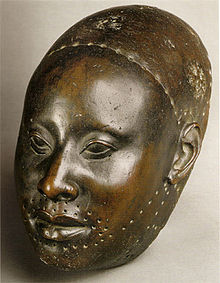
 The Ife Caput on display at the British Museum | |
| Material | "Bronze", actually brass |
| Size | peak: 35 cm width: 12.5 cm depth: xv cm |
| Weight | 5.1 kg |
| Created | 14th/early 15th century[i] |
| Present location | British Museum, London |
| Registration | Af1939,34.1 |
| Culture | Medieval Yoruba |
The Bronze Head from Ife, or Ife Head,[ii] is i of eighteen copper blend sculptures that were unearthed in 1938 at Ife in Nigeria, the religious and former royal centre of the Yoruba people. It is believed to stand for a rex. Information technology was probably fabricated in the fourteenth-fifteenth century C.Eastward.[1] The realism and sophisticated craftsmanship of the objects challenged Western conceptions of African art. The naturalistic features of the Ife heads are unique[3] [1] and the stylistic similarities of these works "suggest that they were made by an individual artist or in a single workshop."[3]
Clarification [edit]
Like about West African "bronzes" the piece is actually made of copper alloyed with other metals, described by the British Museum every bit "heavily leaded zinc-brass". Modernistic practice in museums and archaeology is increasingly to avoid terms such as bronze or brass for historical objects in favour of the all-embracing "copper alloy".[four] The head is fabricated using the lost wax technique and is approximately three-quarters life-size, measuring 35 cm high. The artist designed the head in a very naturalistic manner. The face up is covered with incised striations, but the lips are unmarked. The headdress suggests a crown of complex structure, composed of different layers of tube shaped beads and tassels. This decoration is typical of the statuary heads from Ife.[five] The crown is topped by a crest, with a rosette and a plume which now is slightly aptitude to one side. The crown's surface includes the remains of both red and black pigment. The lifelike rendering of sculptures from mediaeval Ife is exceptional in Sub-Saharan African art, and initially was considered the earliest manifestation of a tradition that continued in Yoruba art, in early Benin art and other pieces. An excavation in Igbo-Ukwu in 1959 provided scientific evidence of an established metal working culture and bronze artefacts that may be dated to the 9th or tenth centuries.
Earthworks & Removal [edit]
The Ife Head was constitute past accident in 1938 at the Wunmonije Chemical compound, Ife, during house-building works amongst sixteen other brass and copper heads and the upper half of a brass figure. Almost of the objects plant in the Wunmonije Compound and neighbouring areas concluded up in the National Museum of Ife, but a few pieces were taken from Nigeria and are now in the collections of major museums. This particular Ife Head was taken from Nigeria by the editor of the Daily Times of Nigeria, H. Maclear Bate, who probably sold it to the National Art Collections Fund,[half-dozen] [7] which and so passed information technology onto the British Museum in 1939.
The discovery of the sculptures was the spur for the government to control the consign of antiquities from Nigeria. Before this was achieved, this head made its mode to London via Paris and another two were sent to America. Attempts to preclude further exports, prompted by Leo Frobenius, were successfully promulgated in 1938, when legislation was enacted by the colonial regime.[8] Frobenius was a German ethnologist and archaeologist who was ane of the commencement European scholars to accept a serious interest in African art, especially that of the Yoruba.
Ife [edit]
The Ife head is thought to be a portrait of a ruler known every bit an Ooni or Oni. It was probably fabricated nether the patronage of King Obalufon Alayemore whose famous naturalistic life-size face mask in copper shares stylistic features with this piece of work. Today amid the Yoruba, Obalufon is identified as the patron deity of brass casters. The period in which the work was fabricated was an age of prosperity for the Yoruba civilization, which was built on trade via the River Niger to the peoples of W Africa. Ife is regarded by the Yoruba people equally the place where their deities created humans.[three]
These bronze heads are evidence of boosted trade since Ife-made glass chaplet have been establish widely in West Africa. The copper is thought to be from local Nigerian ores, although earlier scholars believed it to have come from Primal Europe, North West Mauritania, the Byzantine Empire, or Southern Morocco.
The bronze casts could have been modelled on gimmicky terracotta sculptures.[9] A long[ citation needed ] tradition of terracotta sculpture with similar characteristics existed in the civilization prior to the engagement of the creation of these metallic sculptures. Ivory was another cloth used frequently in African art.
The Ife sculptural tradition is one of several West African artistic traditions, including the Bura of Niger (3rd century CE – 10th century CE), Koma of Republic of ghana (seventh century CE – 15th century CE), Igbo-Ukwu of Nigeria (9th century CE – 10th century CE), and Jenne-Jeno of Mali (11th century CE – twelfth century CE), that may accept been shaped by the earlier West African clay terra cotta tradition of the Nok civilisation of central Nigeria.[10]
Impact on art history [edit]
When Frobenius discovered the first example of a similar caput it undermined existing Western understanding of African civilisation. Experts did non want to believe that Africa had ever had a civilisation capable of creating artefacts of this quality. Attempting to explain what was thought an bibelot, Frobenius offered his theory that these had been cast past a colony of ancient Greeks established in the thirteenth century BC.[xi] He made a claim, widely circulated in the popular press, that his hypothesised ancient Greek colony could exist the origin of the ancient legend of the lost civilization of Atlantis.[12] [13] [fourteen]
It is now recognised that these statues represent an ethnic African tradition that attained a loftier level of realism and refinement.[3] [ failed verification ] [10] The Ife heads are frequently considered a not bad achievement of African civilization, and it is believed that they were made by an individual artist in a unmarried workshop.[3]
Influence on contemporary culture [edit]
There is widespread apply of the Ife Head in logos and branding of Nigerian corporations and educational institutions such as Obafemi Awolowo University in Ile-Ife.[15]
The Ife Head was the symbol for the 1973 All-Africa Games in Lagos.[xvi]
The Ife Head held by the British Museum was included in the 2010 major exhibition Kingdom of Ife: Sculptures from West Africa, developed in partnership with Nigeria's National Commission for Museums and Monuments, the Museum for African Art, New York and the British Museum. The exhibition was role of a serial of events that marked the 50th anniversary of Nigerian independence.[17] In 2011 the Ife Head was included in the British Museum/BBC'due south A History of the World in 100 Objects [18]
See likewise [edit]
- Archaeology of Igbo-Ukwu
- Republic of benin bronzes
- Bronze Head of Queen Idia
References [edit]
Notes
- ^ a b c British Museum. "Object: The Ife Head". British Museum. Archived from the original on twenty April 2021. Retrieved 20 April 2021.
- ^ The name used past the British Museum
- ^ a b c d east Ife head, History of the World in 100 Objects, BBC, retrieved 30 Nov 2013
- ^ The British Museum collection database "scope note" on "copper alloy", "brass" and "bronze" reads "The term copper blend should be searched for total retrievals on objects made or bronze or contumely. This is because statuary and brass have at times been used interchangeably in the quondam documentation, and copper alloy is the Wide Term of both. In addition, the public may refer to sure collections by their popular name, such equally 'The Benin Bronzes' near of which are actually made of brass." British Museum, "Scope Note" for "copper blend". Britishmuseum.org. Retrieved on 2014-05-26.
- ^ Bronzes from Ife and Republic of benin, Peter Herrmann, Berlin, 2007, retrieved xxx Nov 2013
- ^ National Fine art Collections Fund. "Fine art we've helped purchase". Art Fund . Retrieved 21 June 2021.
- ^ Ife head Brass head of a ruler, British Museum highlights, retrieved 30 November 2013
- ^ Hoffman, Barbara T., ed. (2006). Art and cultural heritage : law, policy, and practise (ane. publ. ed.). Cambridge: Cambridge University Press. p. 138. ISBN0521857643.
- ^ Smith, Robert (1988). Kingdoms of the Yoruba (3rd ed.). Madison, Wis.: University of Wisconsin Press. p. 25. ISBN0299116042.
- ^ a b Ramsamy, Edward; Elliott, Carolyn One thousand.; Seybolt, Peter J. (January 5, 2012). Cultural Sociology of the Middle Eastward, Asia, and Africa: An Encyclopedia. SAGE Publications. p. eight.
- ^ Frank Willet (1960). "Ife and Its Archeology". The Journal of African History. 1 (2): 231–248. doi:ten.1017/s002185370000181x.
- ^ On the ruins of Atlantis – Leo Frobenius between enquiry and Vision (in High german) Archived 2013-12-03 at the Wayback Machine, freunde-afrikanischer-kultur.de, retrieved 1 Dec 2013
- ^ "German Discovers Atlantis in Africa; Leo Frobenius Says Find of Bronze Poseidon Fixes Lost Continent's Place" (PDF). The New York Times. January 30, 1911. Retrieved 18 December 2013.
- ^ C. Hercules Read (March 1911). "Plato'due south "Atlantis" rediscovered". Burlington Mag. Vol. eighteen, no. 96. pp. 330–5. Retrieved xviii December 2013.
- ^ Platte, Editha (2010). Bronze Head from Ife. Hambolu, M. O. (Musa O.). London: British Museum Printing. ISBN9780714125923. OCLC 430498709.
- ^ "Kingdom of Ife: sculptures from Westward Africa". British Museum . Retrieved 2018-11-09 .
- ^ "Kingdom of Ife". British Museum . Retrieved 2018-11-ten .
- ^ "BBC - A History of the World - Object : Ife head". www.bbc.co.great britain . Retrieved 2018-11-x .
Further reading
- Suzanne Preston Blier, Art and Adventure in Ancient Yoruba: Ife History, Politics, and Identity c.1300, Cambridge University Printing, 2015
- John Mack (ed), Africa, Arts and Cultures, London 2005
- Editha Platte, Bronze Head from Ife, British Museum Press, 2010
- Frank Willett, The Fine art of Ife (CD Rom), The University of Glasgow, 2004
Source: https://en.wikipedia.org/wiki/Bronze_Head_from_Ife

Publicar un comentario for "Head Is the Oldest Surviving Example of Subsaharan Art From the Culture of Nigeria"