Will Wisconsins Weather Pattern Ever Change Again
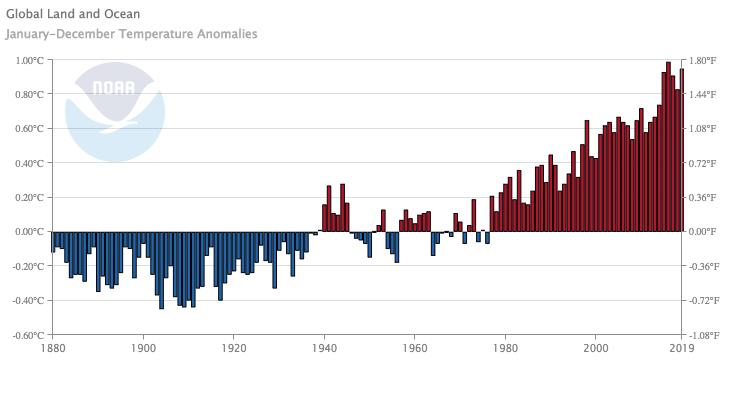
Our climate is changing in many ways. Ane of the clearest signs is that the earth is warming. Scientists know this through bear witness compiled from satellites, atmospheric condition balloons, thermometers, weather stations and more.1 Since 1880, average global temperatures have increased past most 1 degrees Celsius (1.7° degrees Fahrenheit). Global temperature is projected to warm by virtually i.five degrees Celsius (ii.seven° degrees Fahrenheit) by 2050 and 2-4 degrees Celsius (three.6-7.ii degrees Fahrenheit) by 2100.2
According to the National Oceanic and Atmospheric Administration (NOAA), average annual global temperatures have increased steadily since the 1960s. Figure 1 shows deviations from the average global temperature depicted every bit the horizontal line at 0.00 degrees Celsius. Every blueish bar is a twelvemonth that was colder than the average temperature of the 20th century. Red confined are years that were warmer than the 20th century boilerplate. Nineteen of the 20 warmest years have occurred since 2001. It is likely that the coldest year moving forrard volition exist warmer than the warmest year that we experienced in the 20th century.
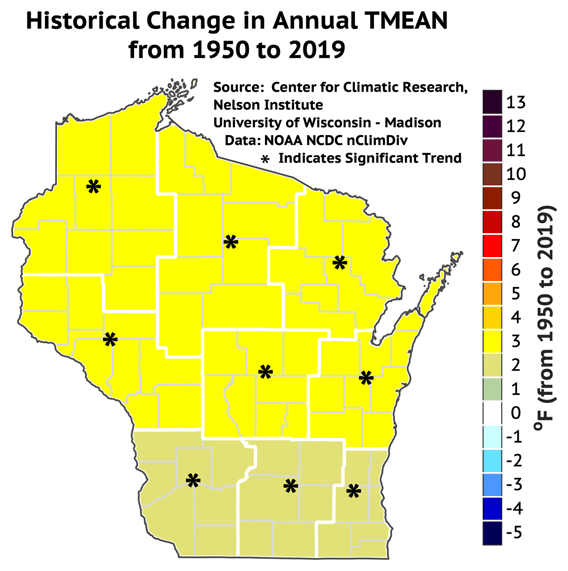
To determine changes in Wisconsin temperature and precipitation, scientists from the University of Wisconsin-Madison analyzed temperature records from a statewide network compiled by the National Climatic Data Center. This dataset shows that Wisconsin has become 2 degrees Fahrenheit warmer and iv.5 inches (14 percent) wetter since the 1950s, with the greatest warming during winter and the largest atmospheric precipitation increase during summer (Figure 2).
Carbon dioxide levels in the temper are increasing
Recordings of daily atmospheric carbon dioxide (CO2), initiated by Dr. Charles David Keeling of the Scripps Plant of Oceanography, help to tell the story of increasing CO2 levels. Keeling was curious whether the increasing amounts of fossil fuel beingness combusted would touch atmospheric CO2 levels. And so, in 1958 he began to record daily atmospheric CO2 levels at the Mauna Loa Observatory in Hawaii. Mauna Loa was selected every bit a long-term monitoring site because it was far from other continents and vegetation that could affect the CO2 concentration. The daily recordings are considered 1 of the world's greatest scientific contributions.
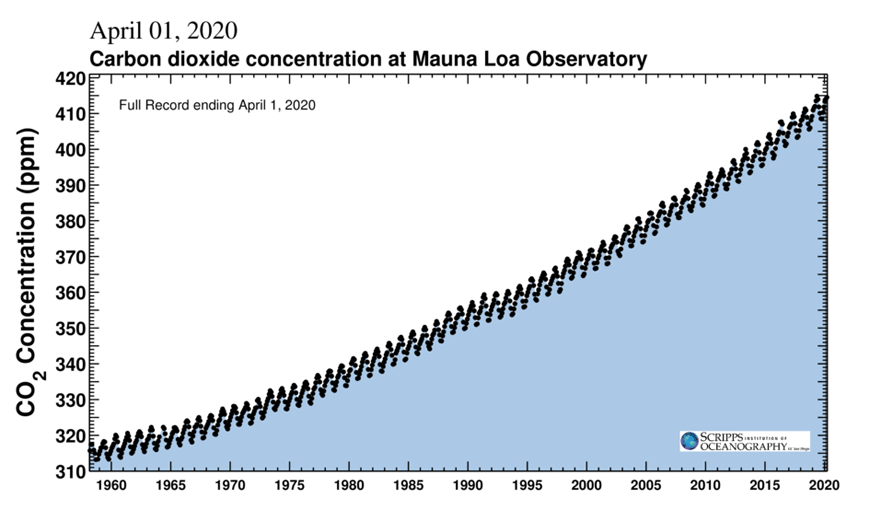
Keeling's measurements discovered an annual planetary cycle in CO2 , in which CO2 levels rise and autumn seasonally (Effigy 3). This cycle is tied to photosynthesis. In the spring every bit plants grow, they have carbon dioxide from the air and using the energy from sunlight, convert it into carbon and release oxygen. In the fall as plants dice, they release CO2 and global CO2 readings ascent.
In addition to the seasonal cycling, Keeling also recorded an increase in CO2 concentration over time, from 313 parts per million (ppm) in 1958 to 415 ppm as of March 30, 2020. This rise in CO2 concentration, known equally the Keeling Curve has transformed the way scientists understand the source of CO2
Increasing carbon dioxide is due to human action
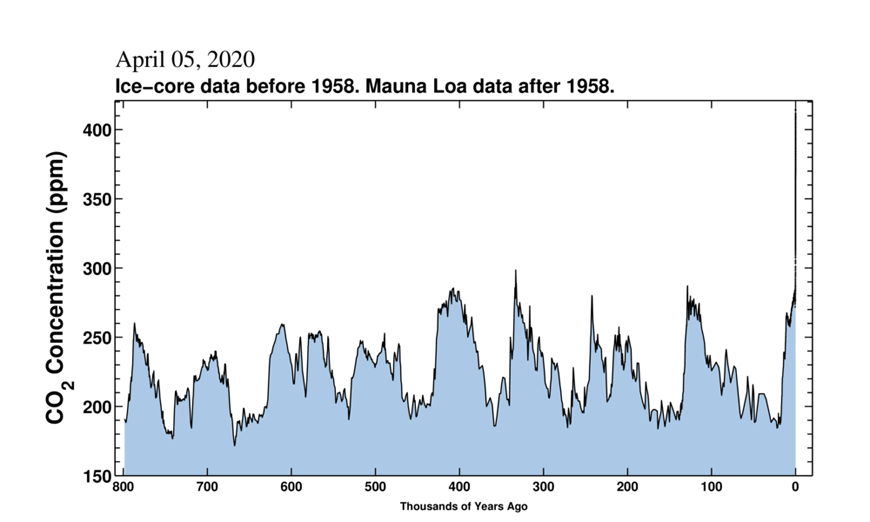
Scientists understand the source of CO2 in the atmosphere from several lines of prove, including measurements of Antarctic ice cores that get back 800,000 years. Antarctic ice cores comprise our atmosphere's history in bubbles of air that were trapped hundreds of thousands of years ago when the ice was beginning formed. Scientists tin can analyze these bubbles to determine how CO2 levels have changed over time.3 The cores show that for the final 800,000 years, until about 1900, CO2 levels were relatively stable, fluctuating between about 150 and 280 ppm. In the early 1900s, CO2 started to increase at an unprecedented rate. Today, only 120 years later, CO2 levels are 40 per centum college than they were before the industrial revolution (Figure 4).
CO2 emissions make up the vast majority of greenhouse gases (GHG) that warm the planet. The Wisconsin Department of Natural Resources Air Management Program has prepared the 2021 Wisconsin Greenhouse Gas (GHG) Emissions Inventory Report (AM-610), identifying CO2 and other GHG emissions in Wisconsin for 2005 and 2018, and describing emission trends from 1990 through 2018. Report authors used the U.S. Environmental Protection Agency's Country Inventory Tool populated with default data.
Downscaling Data to Predict Future Trends: What climate modify ways for Wisconsin
Enquiry conducted past the Wisconsin Initiative on Climate Change Impacts (WICCI), a collaboration of more than 200 scientists and practitioners, provides useful information on the impacts of climate changes, adaptive strategies and solutions to both shop carbon and reduce carbon emissions. The University of Wisconsin-Madison's Nelson Institute for Environmental Studies and the Wisconsin Section of Natural Resources lead WICCI.
WICCI climate scientists accept been able to projection local temperature and atmospheric precipitation patterns for Wisconsin. The scientists took taking global climate models that simulate climate changes on a large scale (typically 100-200 miles) and downscaled them to approximately vi miles. The downscaled models take immune scientists to forecast more realistic, localized temperature and precipitation changes, and changes in extreme weather events. WICCI scientists are continuing to piece of work with people around the land to fine-tune these models and provide forecasts for other climate factors that are important to impacts in Wisconsin.
Temperature
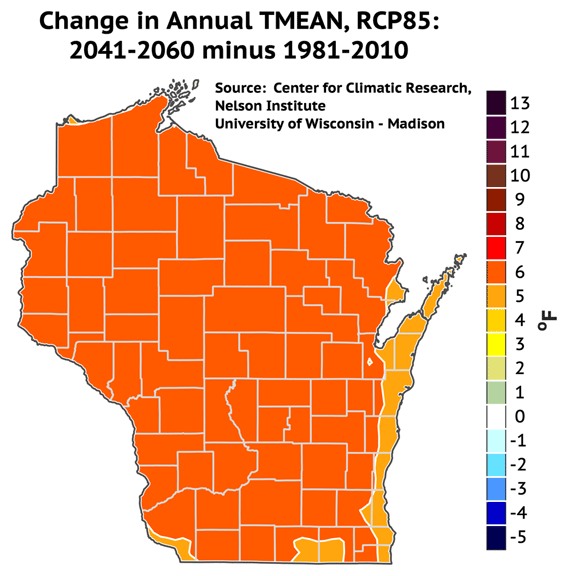
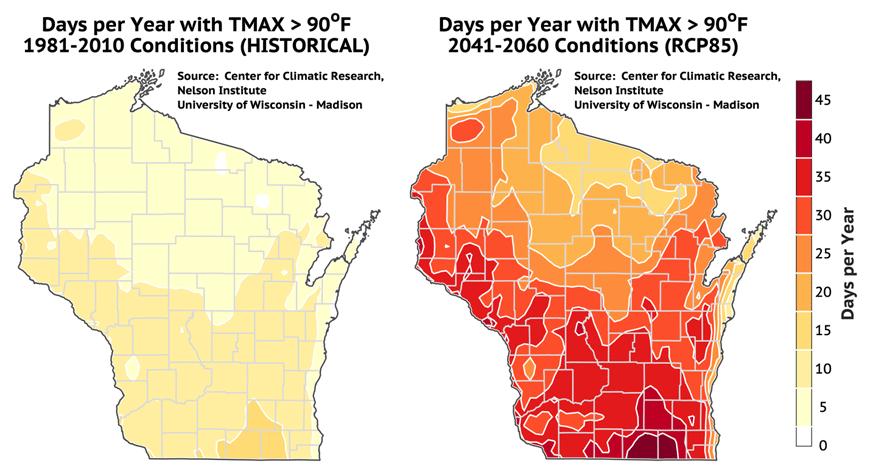
Wisconsin is probable to go a much warmer state over the side by side few decades, with boilerplate temperatures closer to southern Illinois or Missouri. Results show that Wisconsin has warmed 2 to 3 degrees Fahrenheit since 1950, and information technology is projected that the state will warm an additional ii to viii degrees past 2050 (Figure 5). We will besides likely encounter a tripling in the frequency of extreme oestrus (days to a higher place 90 degrees Fahrenheit), rise from nearly 10 days per year in 2020 to about 30 days per year by 2050 (Figure 6).
Seasonal temperatures have also changed. Leap temperatures have increased by 1.7 degrees Fahrenheit with the onset of spring (defined as the date when daily temperatures have reached 50 degrees Fahrenheit for 10 days in a row) coming 3 to 10 days before since 1950. Wisconsin winters are becoming less common cold and have warmed more than any other season in recent decades, especially in the northwestern part of the state where average temperatures take increased by as much as 4.5 degrees Fahrenheit. It is anticipated that winter temperatures will continue to increase 5 to eleven degrees Fahrenheit by 2050 significant winters volition be milder, about one month shorter than they are today, and volition produce virtually fourteen" fewer inches of snow.
Precipitation
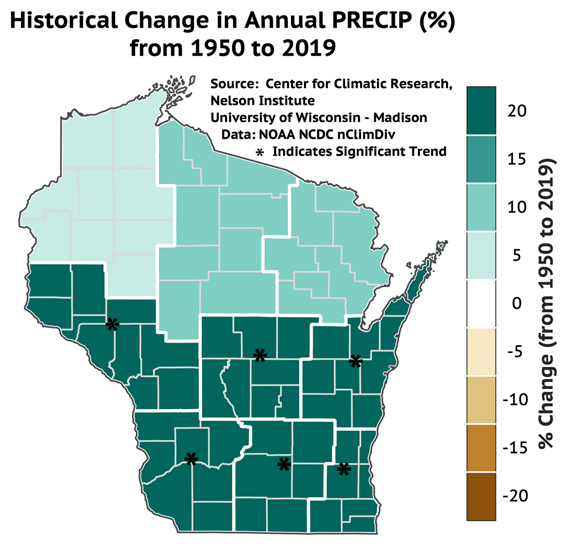
Wisconsin has become virtually 10 to twenty pct wetter since 1950. However, the increment is not evenly distributed geographically. Southern and central Wisconsin have experienced about 20 percent more than atmospheric precipitation than the annual average, while northern Wisconsin has not experienced a pregnant modify in almanac precipitation (Figure 7). Although projections of precipitation are less sure than projections of temperature, scientists study that almanac boilerplate atmospheric precipitation volition likely increase by 2050, especially during autumn, winter and leap. Further, in winter nosotros are likely to run into more atmospheric precipitation as pelting rather than snow.
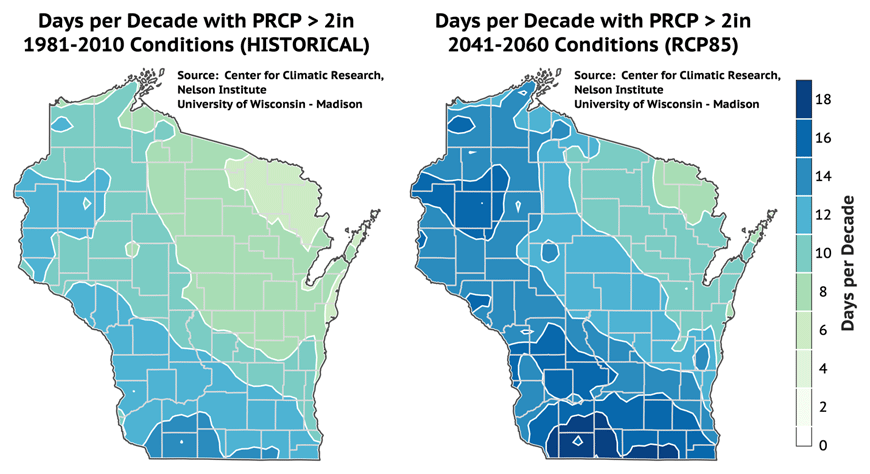
In addition to tracking average precipitation, WICCI scientists project the frequency and intensity of storms. Extreme precipitation events have had devastating consequences in Wisconsin, and they take been increasing across the state. In the Bully Lakes region, rainfall in the heaviest 1 percent of rain events increased by 31 per centum between 1958 and 2007.4 These kinds of extreme events are likely to become more frequent, and more severe every bit our climate changes. WICCI projections suggest a 30 percent increase in the frequency of 2 inch rainfall events, and a near doubling of 5 inch rainfall events (Figure viii).
Health impacts and Community Resilience
The U.S. Department of Wellness and Human Services considers climate change such as increasing temperature, humidity, precipitation and farthermost conditions – ane of the top public health threats of our time. Extreme heat kills more people in the U.S. than whatsoever other weather-related disaster and tin disproportionately affect vulnerable populations such as elderly, socially isolated people and those with chronic wellness conditions such equally cardiovascular disease.five,vi
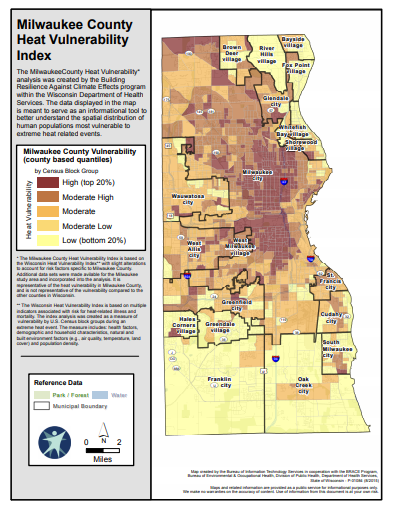
Heavy rains and flooding can overwhelm sewer and stormwater systems and increment polluted runoff to lakes and streams. Changes in temperature and atmospheric precipitation can also bear upon affliction-carrying insects such as ticks and mosquitos. Wisconsin'southward reported incidence of Lyme disease, a affliction transmitted by ticks, is amidst the highest in the country. The rate of disease has doubled in the by decade.7
Many studies have shown that the negative health impacts of climatic change are not equally distributed. Structural racism has historically been a large factor in determining what communities are nigh negatively impacted past environmental health issues including climate change. For example, people of colour and low-income communities are exposed to air pollution and extreme heat at higher rates. Air pollution, when combined with extreme heat caused by climate change, contributes to disproportionate rates of asthma in people of color and low-income communities.
In a study of 108 U.South. cities, researchers plant that when a heatwave impacts a city, poorer neighborhoods are hotter by an boilerplate of 5 degrees, but some neighborhoods are hotter by nearly xiii degrees8. Lower-income urban areas typically accept more than paved surfaces and fewer shade trees, parks, and green spaces, and residents typically have less access to air conditioning, increasing the take a chance of heatstroke. A 2020 written report of 115 cities by the Academy of Wisconsin-Madison and the Medical Higher of Wisconsin constitute lower tree awning and higher air pollution in the poorest neighborhoods.9
1https://www.climate.gov/news-features/understanding-climate/climate-alter-global-temperature
2 Affiliate 12 of the IPCC: Collins, Yard., R. Knutti, J. Arblaster, J.-L. Dufresne, T. Fichefet, P. Friedlingstein, X. Gao, Due west.J. Gutowski, T. Johns, Yard. Krinner, Yard. Shongwe, C. Tebaldi, A.J. Weaver and Chiliad. Wehner, 2013: Long-term Climate Alter: Projections, Commitments and Irreversibility. In: Climatic change 2013: The Physical Scientific discipline Basis. Contribution of Working Grouping I to the Fifth Cess Report of the Intergovernmental Panel on Climatic change [Stocker, T.F., D. Qin, G.-K. Plattner, M. Tignor, S.K. Allen, J. Boschung, A. Nauels, Y. Xia, V. Bex and P.M. Midgley (eds.)]. Cambridge University Press, Cambridge, Uk and New York, NY, Usa. https://www.ipcc.ch/report/ar5/syr/
3https://world wide web.bas.ac.uk/data/our-data/publication/ice-cores-and-climate-change/
fourhttps://www.northland.edu/wp-content/uploads/2019/05/CRC-ClimateChangeAdaptationGuide.pdf See page 32.
vhttps://www.ready.gov/heat
vihttps://www.dhs.wisconsin.gov/climate/wihvi.htm
viihttps://www.dhs.wisconsin.gov/tick/lyme-about.htm
8https://www.mdpi.com/2225-1154/8/ane/12/htm
ninehttps://www.ncbi.nlm.nih.gov/pubmed/31884239
Source: https://dnr.wisconsin.gov/climatechange/science#:~:text=Wisconsin%20is%20likely%20to%20become,by%202050%20(Figure%205).

Publicar un comentario for "Will Wisconsins Weather Pattern Ever Change Again"